Day of Brahma
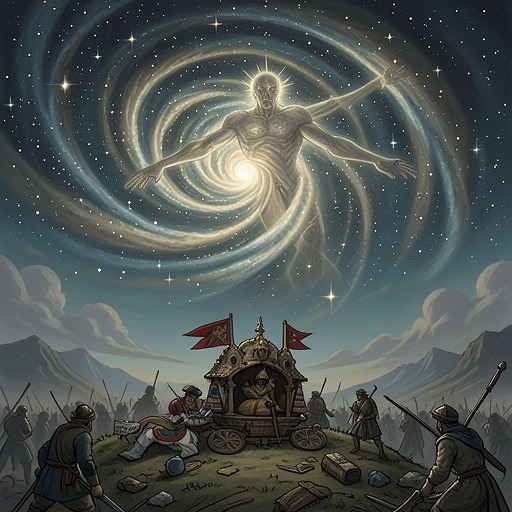
Bhagavad GitaThe Day of Brahma is the expansive phase of a cosmic cycle in which the manifest universe comes forth from the unmanifest. Its decisive significance is that it places human birth, death, and spiritual release within a scale far larger than ordinary history: worlds appear and disappear in recurring periods, while the Supreme goal lies beyond the cycle altogether.
Definition and Cosmic Duration
The Day of Brahma is described as lasting for a thousand Yugas, matched by a Night of Brahma of equal duration. Those who understand this vast alternation are said to understand day and night on the cosmic level, rather than merely as human measures of time. The scale transforms time from a linear sequence into a recurring rhythm of manifestation, withdrawal, and renewed manifestation.
This cosmic day belongs to the order of Brahma, whose realm stands at the summit of the worlds that remain subject to rebirth. Even the highest created regions, from the abode of Brahma downward, are not presented as permanently secure. Reaching Krishna, by contrast, ends rebirth; the Day of Brahma therefore defines the upper limit of cyclical existence rather than the final destination of the soul.
Emergence and Dissolution
At the advent of the Day of Brahma, everything manifest springs from the unmanifest. The movement is not described as a single historical creation but as the reappearance of the entire assemblage of creatures under the force of action and its consequences. When the cosmic night arrives, those manifest beings dissolve back into the same unmanifest condition. The day and night thus form two complementary phases of one process.
The cycle repeats. Creatures spring forth again and again when the day comes, then disappear when night comes, only to emerge once more in the next period of manifestation. This recurrence gives cosmic scale to the Gita's broader teaching that action has consequences and that beings remain bound within processes they do not fully control. Creation is neither an isolated beginning nor a final event; it is a repeated return.
Beyond the Cosmic Cycle
The teaching distinguishes the ordinary unmanifest state from another unmanifest and eternal entity beyond it. Unlike the manifest entities that are destroyed when the cosmic night arrives, this higher reality is not destroyed. It is called indestructible and is identified as the highest goal, the Supreme seat from which no one returns.
This distinction prevents the Day of Brahma from becoming the ultimate horizon of existence. Cosmic renewal may be immense, but it remains part of the realm of change. The eternal reality beyond the unmanifest offers a different kind of permanence: not the continuation of a world through repeated cycles, but release from the need to return to any world at all.
Human Spiritual Implication
The doctrine is presented within Krishna's instruction to Arjuna, whose immediate setting is the sacred plain of Kurukshetra and whose dilemma concerns action, death, and duty. Against that battlefield crisis, the Day of Brahma relativizes individual mortality without making action meaningless. Bodies and worlds pass through manifestation and dissolution, while disciplined devotion directs the person toward what is beyond both.
Krishna therefore joins cosmic knowledge to practical conduct. Arjuna is told to remember Krishna and engage in battle, fixing mind and understanding on him. The teaching does not ask him to escape the world merely because the world is temporary; it asks him to act without losing sight of the imperishable goal. Knowledge of the Day of Brahma becomes a way of resisting delusion while remaining committed to one's own duty.
Relation to the Two Paths
The Day of Brahma also belongs to the Gita's account of the two routes taken by devotees after death. The path associated with fire, light, day, the bright fortnight, and the six months of the sun's northern course leads those who know Brahman toward Brahman without return. The contrasting path of smoke, night, the dark fortnight, and the six months of the sun's southern course leads to lunar light and eventual return.
These paths sharpen the difference between cyclical continuity and final liberation. The cosmic day can bring forth the universe again, and the favorable path can carry a knower beyond rebirth, but the other path returns the devotee to the cycle. Knowing both paths, the devotee is not deluded and remains devoted at all times, seeking the Supreme and primeval seat rather than merely a temporary elevation within the cosmos.